




BNP acting chief Tarique Rahman returns to Bangladesh ahead of general elections
Rahman, who was in exile for 17 years, is now a key contender to be the next prime minister of the country.
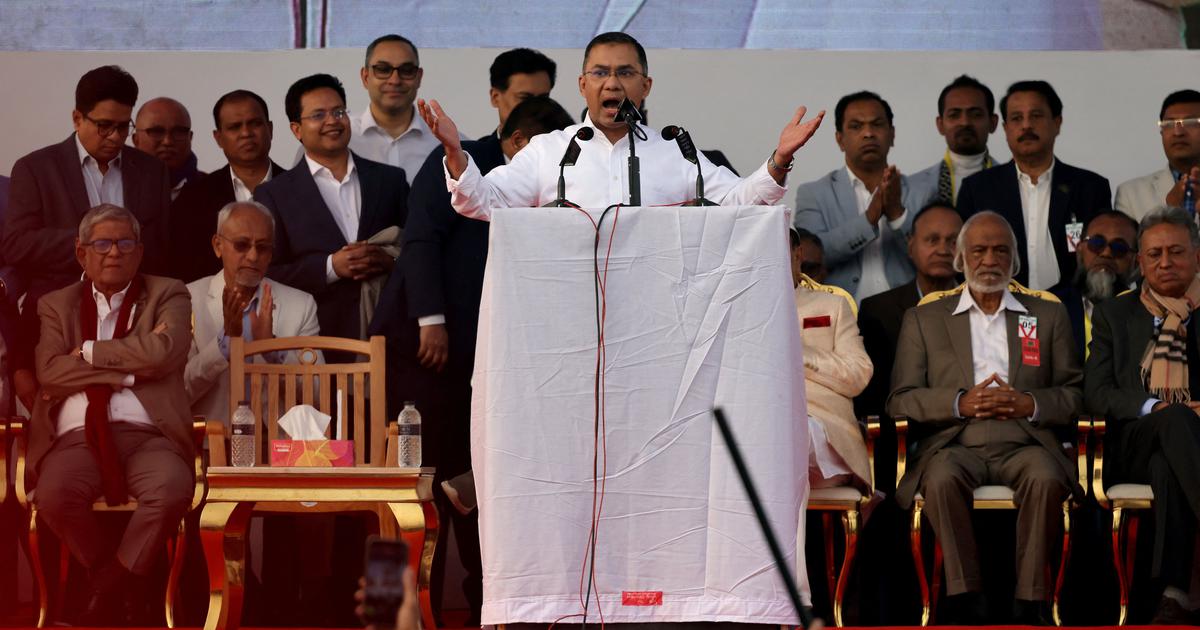
Tarique Rahman, the acting chairperson of the Bangladesh Nationalist Party and son of former Prime Minister Khaleda Zia, returned to the country on Thursday after 17 years in exile, reported The Daily Star.
Rahman, who is a key contender to be the next prime minister of the country after the general elections in February, had been living in London since he fled Bangladesh in 2008.
He was sentenced to life in prison for allegedly masterminding a grenade attack on a rally in 2004 that killed 24 leaders and activists of ousted Prime Minister Sheikh Hasina’s Awami League.
While in exile, he was also convicted on charges of money laundering and faced around 100 lawsuits. The convictions were overturned after Hasina was ousted from power in August 2024, following large-scale student-led protests against her government.
Soon after landing in Bangladesh on Thursday, accompanied by his wife Zubaida Rahman and daughter Zaima Rahman, he spoke at a massive rally in Dhaka. He outlined his vision for the country and invoked the words of American civil rights activist Martin Luther King.
Rahman said that King had stated in a public speech: “I have a dream.”
“Like him, I want to say, I have a plan for Bangladesh,” reported Prothom Alo.
He also referred to the killing of student leader Sharif Osman Bin Hadi on December 12 in Dhaka.
Tarique said that Hadi wanted the citizens of the country to regain their economic rights, reported The Daily Star. “If we are to repay the debt of the blood of those who were martyred in 1971 and 2024, we must build the Bangladesh we all dream of,” he said.
The death of Hadi, a prominent leader of the student-led movement against the Hasina government, triggered protests, vandalism and clashes in several parts of Bangladesh.
Stones were thrown at the residence of the assistant Indian high commissioner in Chittagong on Thursday. The offices of newspapers and properties linked to Hasina’s Awami League were also attacked.
On Sunday, New Delhi suspended visa operations at its Chittagong centre and heightened security around Indian missions following attacks in Bangladesh.
Rahman claimed during the rally on Thursday that “agents of various dominant powers are still engaged in conspiracies” in the country, reported The Daily Star.
“We must remain patient,” he said. “We have to exercise caution.”
He added that the citizens of Bangladesh want to regain their right to speak.
“They want to get back their democratic rights,” said Rahman. “The time has come for all of us to build the country together. This country belongs to people of the hills and the plains, Muslims, Hindus, Buddhists and Christians. We want to build a safe Bangladesh, where every woman, man, and child can leave home and return safely.”
Rahman’s return to Bangladesh ahead of the 13th national election, to be held on February 12, is being seen as a defining moment for the Bangladesh Nationalist Party, according to reports.
This will be the first election in the country since the ouster of Hasina.
On December 11, while announcing the elections, the country’s Chief Election Commissioner AMM Nasir Uddin said that a national referendum on the “July Declaration” would also be held on the same day.
The declaration promises full state and constitutional recognition of the 2024 student protests.
In August, Muhammad Yunus, the head of the country’s interim government, said that the declaration was essential to ensure “no future government can become fascist again”.
Yunus, a Nobel laureate economist, took over as chief adviser of Bangladesh’s interim government three days after Hasina resigned as the prime minister and fled to India on August 5, 2024.
Hasina was ousted from power after being the prime minister of Bangladesh for 16 years.
Yunus has pledged to step down once an elected government took office.
The last elections in the country were held in January 2024, when Hasina returned to office for a fourth consecutive term. The Awami League had won 222 out of the 300 elected seats in Parliament. Notably, the vote was boycotted by her main rivals, who accused her administration of rigging the result.
In May, Bangladesh’s interim government banned all activities of the Awami League, including its online platforms, under the country’s anti-terrorism act.
